


Here’s the latest news, resources, and use cases from the world of product, UX, AI and technology. Let’s go:
📊 AI in Healthcare
👩💻 AI in 2026
🤝 AI Pragmatism
🗑️ AI Slop
💩 Grok
📺 Brainrot
👴 Alzheimer’s
Podcast
Harnessing AI in Healthcare: Insights from RJ Kedziora
In this episode of Product by Design, Kyle Evans interviews RJ Kedziora, co-founder of Estenda, a company specializing in custom software and data analysis for healthcare. We discuss RJ’s journey in technology and entrepreneurship, the importance of energy management over time management, and the role of AI in healthcare. RJ shares insights into the challenges and future of AI applications, the need for ethical considerations, and the potential for personalized healthcare solutions. He also offers advice to aspiring entrepreneurs looking to make a difference in the industry.
News and Useful Reads
17 predictions for AI in 2026
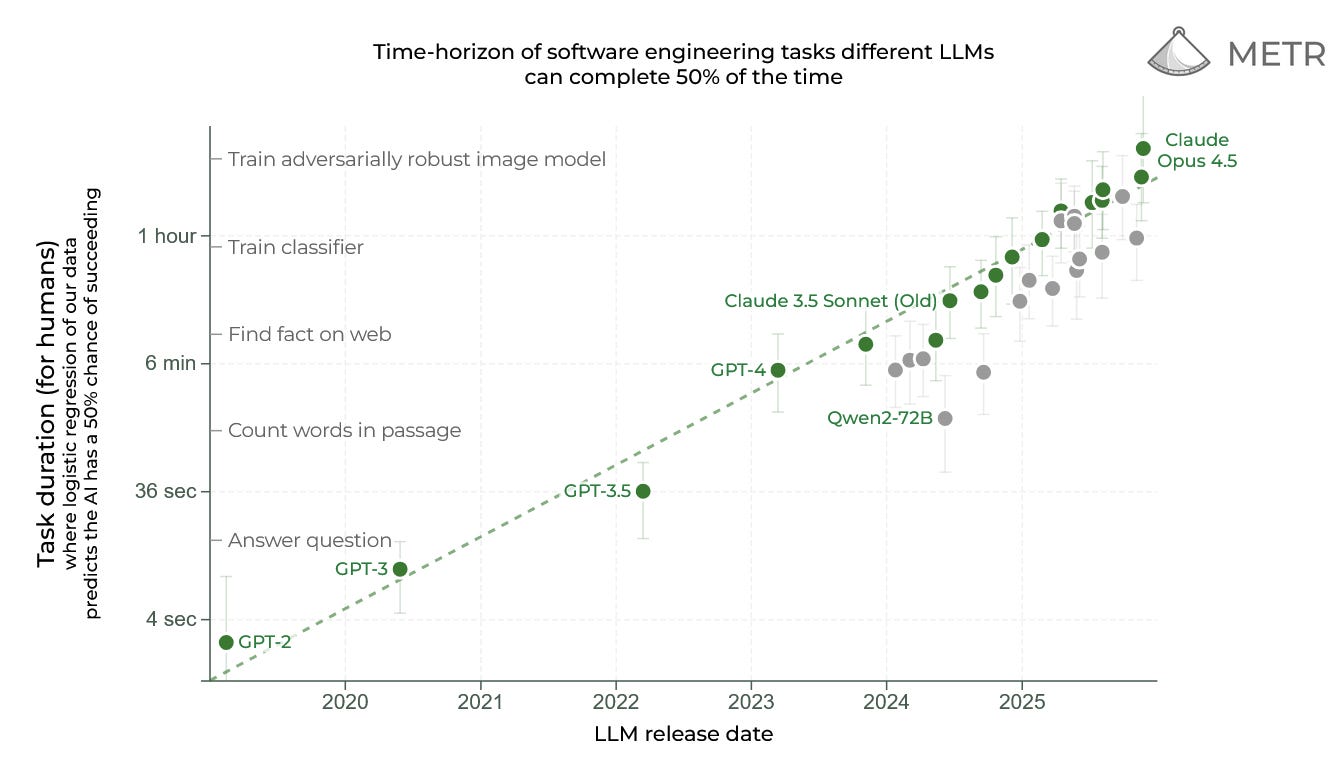
Will AI models be able to successfully complete about half a week’s work of a software engineer? Possibly. Especially if they continue to improve at the rate they have been.
The AI evaluation organization METR released the original version of this chart in March. They found that every seven months, the length of software engineering tasks that leading AI models were capable of completing (with a 50% success rate) was doubling. Note that the y-axis of this chart is on a log scale, so the straight line represents an exponential increase.
In 2026, AI will move from hype to pragmatism
2025 was about creating the largest LLMs. 2026 will (hopefully) be about making AI far more practical.
The focus is already shifting away from building ever-larger language models and toward the harder work of making AI usable. In practice, that involves deploying smaller models where they fit, embedding intelligence into physical devices, and designing systems that integrate cleanly into human workflows.
AI Slop won in 2025 — fingerprinting real content might be the answer in 2026
It’s on ongoing game in our house to point out when we think something was created using AI. One of the easiest tells is when it is too perfect or polished. As we move into the new year, I expect we’ll continue to see a trend toward authenticity and human imperfection, rather than AI generated slop.
The battle against AI content is lost. Slop fills our feeds, and it's up to us to discern what is real. But what if 2026 represents the dawn of a new approach, a flipping of the script where we no longer chase identifying what's artificially created and instead fingerprint the real?
Grok is undressing anyone, including minors
Unsurprisingly, Grok is creating questionable content with few guardrails.
xAI’s Grok is removing clothing from pictures of people without their consent following this week’s rollout of a feature that allows X users to instantly edit any image using the bot without needing the original poster’s permission.
Online ‘brainrot’ isn’t ruining children’s minds – it’s a new way of navigating the modern internet
When I was younger, we constantly quoted movies and popular shows with each other. It was a way to connect, much like the “brainrot” of today.
Although brainrot is often used knowingly and with a touch of irony to describe these phrases, remixing and repeating fragments of media has always been part of how people connect. It creates a shared cultural code, a second language made of references, rhythms and sounds that bind groups together and turn everyday moments into opportunities for humour and social connection.
Other Interesting Finds
Alzheimer’s Fully Reversed in Mice, Scientists Say
I’m hopeful that we could see an end to Alzheimer’s soon. This could be one of the greatest modern-day breakthroughs in medicine.
“The key takeaway is a message of hope — the effects of Alzheimer’s disease may not be inevitably permanent,” said Andrew A. Pieper, the study’s principal investigator and a CWRU neuroscience professor, in a statement about the research. “The damaged brain can, under some conditions, repair itself and regain function.”