


Years ago, I worked with an executive team at a small organization. One of the first things we discussed was the vision and strategy of the organization. The CEO articulated to me that the vision of the company was to “grow to be a $50 million ARR company.” And the strategy was to expand its two primary divisions by 20% each year.
My immediate thought was, “This isn’t a vision or a strategy.” And it wasn’t. Or at least it was a very poor vision and strategy.
Many of us have probably experienced something similar to my experience above. In fact, I’ve seen this at many companies over the years. While leaders will often spend days or weeks creating a “strategy” for their organization, they’ll completely miss the mark.
So what makes for a good strategy or a bad strategy? That, of course, is the topic of the book Good Strategy/Bad Strategy by Richard Rumelt.
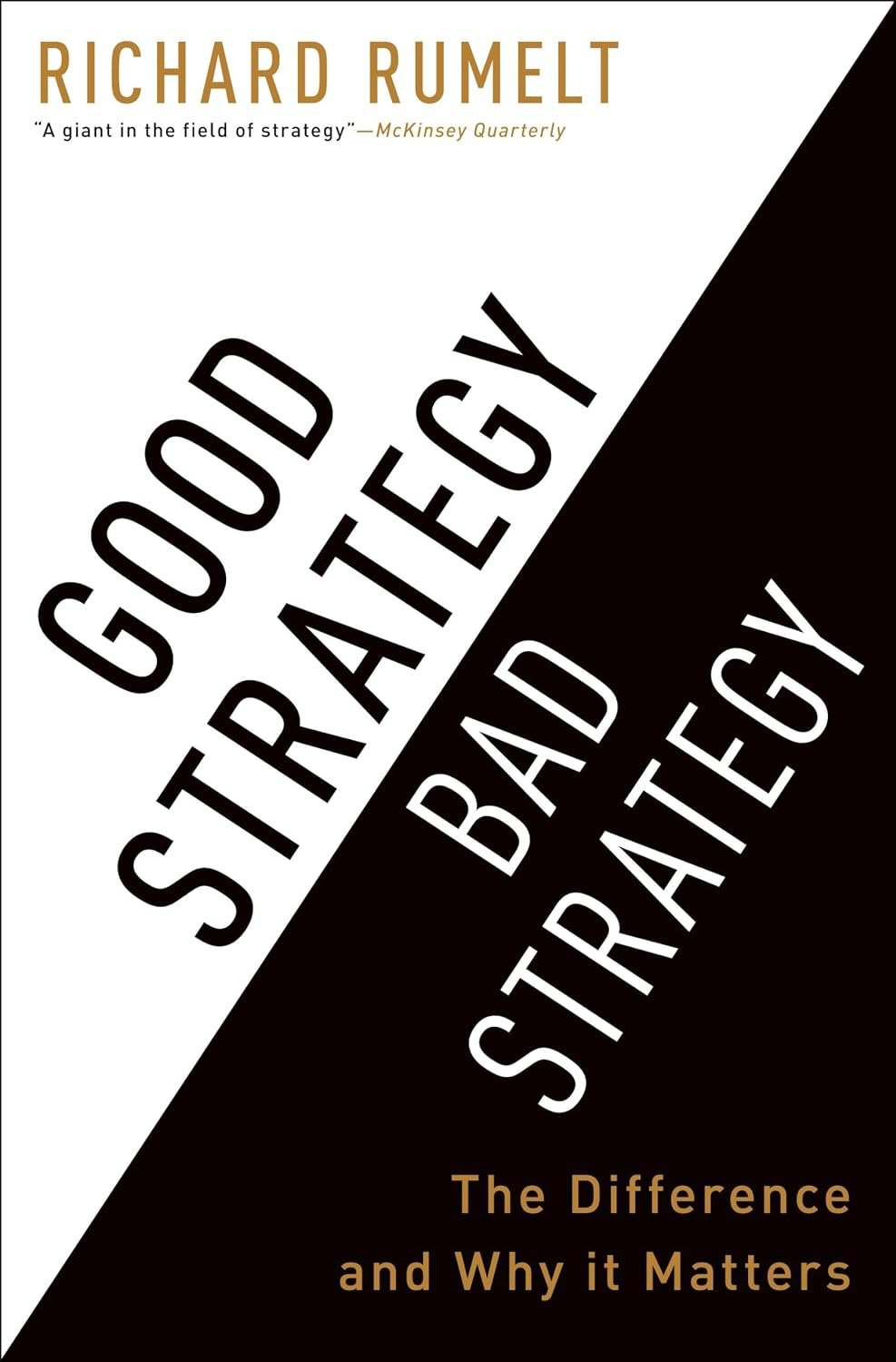
In this book, Richard Rumelt argues that what most organizations call “strategy” is actually goal-setting or wish lists. Good strategy is actually rare, primarily because it identifies a critical obstacle and concentrates the effort on overcoming it.
The book is divided into three parts: what bad strategy looks like and why it’s so common, the structure of good strategy (the “kernel”) and its sources of power, and how to think like a strategist. It’s built on many cases from business, military history, and government, which helps to make the idea concrete rather than just theoretical.
So let’s dive in.
Key Takeaways
While there is a lot to take in from this book, I want to focus on a couple of key ideas that I took away from this book.
A Strategy Includes The Kernel
Every good strategy has three parts, referred to in the book as “the kernel.” The kernel includes a diagnosis, a guiding policy, and coherent action. Most bad strategies skip at least one of these parts.
